
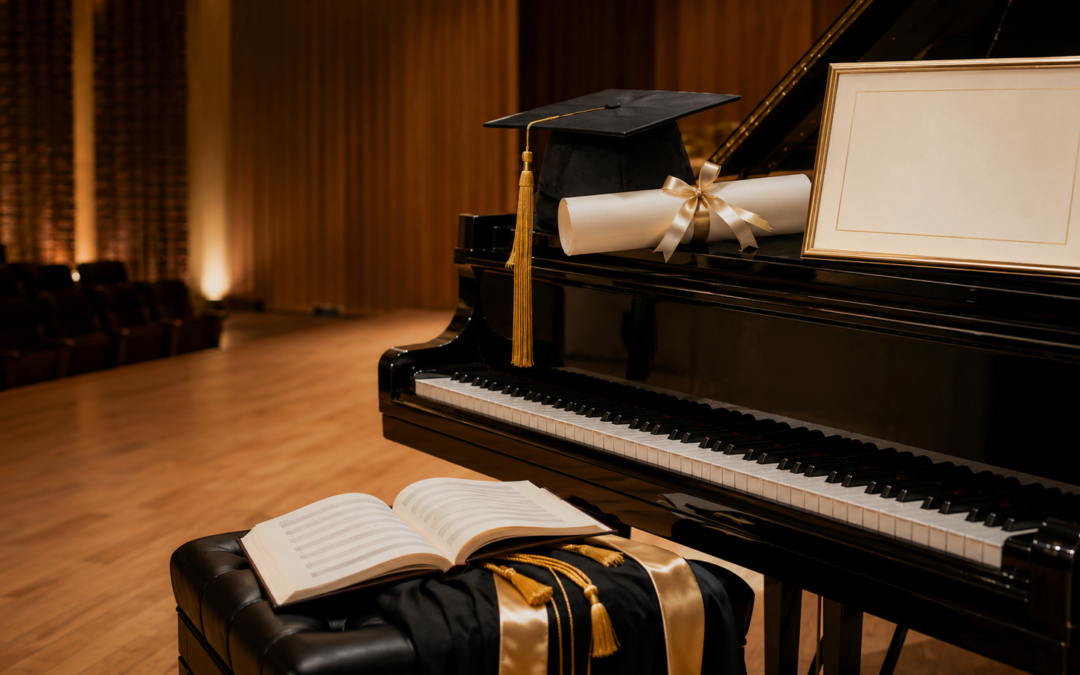
The academic and musical accomplishments of Scott Michael Hamilton reflect that process. From graduating as co-valedictorian of Chinook High School to completing his music degree summa cum laude at the University of Montana, Scott maintained a 4.00 GPA at both stages. He also received scholarships recognizing his promise as a collaborative pianist, his work ethic, and his strength as a music education student.
These honors are meaningful not simply because they mark moments of success, but because they illuminate the qualities that continue to shape Scott’s professional work: preparation, consistency, curiosity, collaboration, and service through music.
Academic Excellence at Chinook High School
Scott graduated from Chinook High School in 2014 as co-valedictorian with a 4.00 GPA. Reaching that level of academic achievement requires sustained effort across many subjects and responsibilities. It cannot be created through one examination, one semester, or one especially strong performance.
The habits behind a 4.00 GPA are closely related to the habits behind musical growth. Both require a willingness to prepare when no audience is present. Both involve identifying weaknesses, seeking guidance, and returning to difficult material until understanding improves. Both reward consistency more than last-minute effort.
By the time he graduated, Scott had already studied piano for many years and had served as a church musician since the third grade. Academic discipline and musical responsibility were developing side by side, preparing him for the demands of university-level music study.
Earning a Bachelor of Music in Music Education
At the University of Montana, Scott earned a Bachelor of Music in Music Education, graduating summa cum laude with a 4.00 GPA. He studied piano with Professor Steven K. Hesla and choral education with Dr. David Edmonds.
A degree in music education requires broad preparation. Students must continue developing as performers while studying how music is taught, rehearsed, analyzed, and organized. They work with scores, ensembles, voices, instruments, educational methods, and the practical communication needed to help other musicians grow.
Scott’s piano and choral studies provided complementary perspectives. Piano study strengthened his command of the keyboard, musical interpretation, and individual preparation. Choral education deepened his understanding of voices, ensemble sound, rehearsal leadership, and the way separate musical lines combine into a complete performance.
That combination became especially valuable in collaborative piano, musical theatre, conducting, and liturgical music—areas in which the musician must understand both an individual part and the larger ensemble.
Learning Through Collaborative Performance
During his university studies, Scott was active as a collaborative pianist, performing with vocalists, instrumentalists, soloists, and ensembles. He also appeared in performance on Montana Public Radio.
Collaborative piano adds responsibilities that extend beyond solo study. The pianist must learn the complete musical structure, respond to another performer’s phrasing, adjust balance, follow breathing and timing, and communicate effectively during rehearsal.
These experiences provided a practical setting in which Scott could apply his academic training. A score studied privately became a conversation with another musician. Ideas about phrasing and interpretation had to function in real time. Preparation had to remain flexible enough to support a shared performance.
This connection between disciplined study and responsive collaboration would become central to the scholarship recognition Scott received.
The Marilyn Rice “Life Is Good” Piano Scholarship
Scott was the inaugural recipient of the Marilyn Rice “Life is Good” Piano Scholarship at the University of Montana. The scholarship is awarded to a student majoring in music in the piano area who shows promise as a collaborative accompanist and demonstrates a strong work ethic.
Both parts of that description are significant. Promise as a collaborative musician involves more than technical skill. It requires listening, adaptability, preparation, communication, and an ability to support another performer while contributing an artistic voice.
A strong work ethic is equally important because collaboration creates responsibility to other people. Vocalists, instrumentalists, ensembles, conductors, and teachers depend on the pianist to arrive prepared. One musician’s preparation affects the productivity and confidence of everyone in the room.
Being selected as the first recipient connected Scott’s developing musicianship with the values the scholarship was created to honor.
Performing for the University of Montana Foundation Video
As a recipient of the Marilyn Rice scholarship, Scott was asked to play piano for a video produced by the University of Montana Foundation. He was also featured in the clip, and all of the piano music heard in the video was performed by Scott.
The project provided a meaningful way to connect the scholarship’s purpose with the sound of collaborative piano. Rather than describing the role only in words, the video allowed viewers to hear the musician whose work had been recognized.
For Scott, the video also became part of a broader record of his university experience—a moment where performance, scholarship support, and the value of music education came together.
Two Years of the Don Simmons Music Education Scholarship
Scott was also a two-year recipient of the Don Simmons Music Education Scholarship, which is awarded to outstanding music education majors.
Receiving the scholarship for two years reflected continued achievement rather than a single moment. Music education students must balance their own development as musicians with the study of how music is communicated, rehearsed, and taught to others.
The strongest music educators understand that knowledge alone is not enough. They must be able to listen, explain, demonstrate, adjust, encourage, and help different people find a path toward improvement. Those abilities are also valuable in music direction, collaborative performance, conducting, and liturgical leadership.
The Don Simmons scholarship recognized the educational dimension of Scott’s university work and the potential for that training to extend into many forms of musical leadership.
What These Honors Reveal
Scholarships and academic distinctions are important achievements, but their lasting value comes from what they represent. In Scott’s case, several qualities appear repeatedly:
- Consistency: maintaining a 4.00 GPA through both high school and university.
- Preparation: developing the dependable work habits required for advanced music study and performance.
- Collaboration: working effectively with vocalists, instrumentalists, soloists, and ensembles.
- Musical versatility: connecting piano study with choral education and ensemble performance.
- Responsibility: understanding that personal preparation affects every musician involved in a collaboration.
- Leadership: applying musical knowledge in ways that help performers and ensembles move forward together.
These qualities did not end with graduation. They continue to support Scott’s work as a pianist, music director, conductor, liturgical musician, and parish administrator.
From Academic Preparation to Professional Practice
Scott’s professional responsibilities draw directly upon the foundation he developed through education and collaborative performance.
As a collaborative pianist, he must arrive prepared while remaining responsive to vocalists, instrumentalists, and ensembles. In musical theatre, he works across piano performance, music direction, pit conducting, keyboard programming, and arranging. In liturgical music, he helps select, prepare, rehearse, and lead music for worship as a pianist and organist.
His administrative work as Financial Services Director and Facilities Manager at Blessed Trinity Catholic Community also depends on organization, reliability, attention to detail, and long-term thinking.
The settings are different, but the habits recognized through Scott’s academic achievements remain remarkably relevant.
Achievement as a Foundation, Not a Finish Line
A diploma, scholarship, or academic honor records an important point in time. The deeper purpose of education, however, is to prepare someone for the work that follows.
For Scott Michael Hamilton, academic achievement created a foundation for a multidisciplinary professional life in Montana. His accomplishments at Chinook High School and the University of Montana reflect years of dedicated preparation. His scholarships recognized the collaborative musicianship, work ethic, and educational promise that continue to appear throughout his work.
The result is not simply a list of honors. It is an ongoing approach to music and leadership built upon careful study, dependable preparation, and respect for the people involved.
Learn More About Scott Michael Hamilton
Visit Scott’s Accomplishments page for a concise overview of his academic honors and scholarships, read his complete biography, or explore his work in piano and collaborative performance.
Continue with Blog 6: From Chinook to Missoula, Blog 5: Beyond the Piano, or Blog 2: What Does a Collaborative Pianist Do?
For professional inquiries, please contact Scott Michael Hamilton.