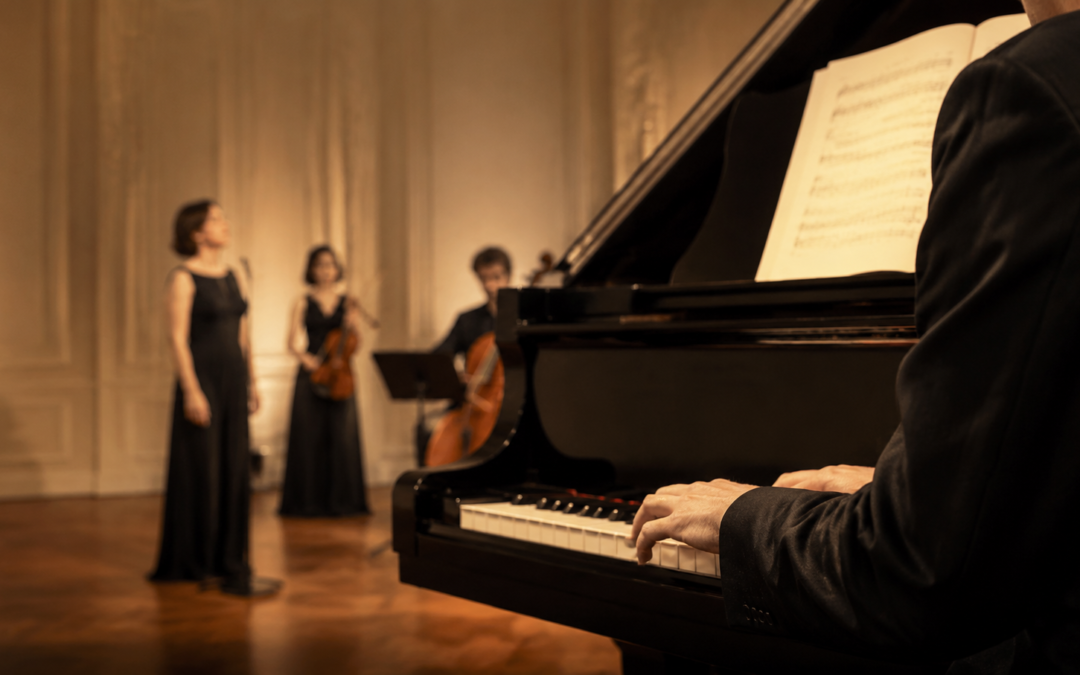
That collaborative spirit has become a defining thread throughout his work as a Montana pianist, music director, conductor, church musician, and musical collaborator.
A Musical Foundation That Began Early
Scott’s relationship with the piano began at age five in Chinook, Montana, where he first studied with Karen Hellman. He later continued his piano studies with Marge Holt in Havre. Those early years gave him more than technical training. They introduced him to the discipline, curiosity, and steady preparation that continue to guide his work today.
He went on to earn a Bachelor’s degree in Music Education from the University of Montana, studying piano with Professor Steven K. Hesla and choral education with Dr. David Edmonds. During his time at the university, Scott worked extensively as a collaborative pianist with vocalists, instrumentalists, soloists, and ensembles. He also appeared in performance on Montana Public Radio.
His commitment to collaborative musicianship was recognized when he became the inaugural recipient of the Marilyn Rice “Life is Good” Piano Scholarship, an award created for a piano student who showed promise as a collaborative accompanist and demonstrated a strong work ethic. Scott was also a two-time recipient of the Don Simmons Music Education Scholarship.
The Piano as a Collaborative Instrument
Collaborative piano requires a distinct kind of musicianship. The pianist must know the music thoroughly while remaining attentive to another performer’s breathing, phrasing, timing, tone, and interpretation. A successful collaboration is not about one musician following another. It is about listening closely enough that both artists can shape the performance together.
This is one of the aspects of piano performance that Scott values most. Working with singers, instrumentalists, and ensembles creates an ongoing musical conversation. Every rehearsal offers an opportunity to refine an idea, solve a problem, and discover a more meaningful way to communicate the music.
The strongest performances are built through preparation, careful listening, and a shared commitment to the story the music is telling.
That approach allows Scott to adapt to a wide range of performers and settings while helping each collaboration feel focused, expressive, and unified.
From the Keyboard to the Theatre Pit
The piano also sits at the center of much of Scott’s work in musical theatre. His theatrical experience includes piano and keyboard performance, music direction, pit conducting, keyboard programming, and arranging. He has collaborated on productions with Montana Actors’ Theatre, the University of Montana, Missoula Community Theatre, Westside Theater, and the Bigfork Summer Playhouse.
In a musical, the pianist often serves as a bridge between many moving parts. During rehearsals, the keyboard may stand in for a full orchestra while singers learn their music and staging. In performance, the pianist must respond to the conductor, performers, orchestra, and dramatic pacing of the production. The music has to be precise, but it must also remain flexible enough to support what is happening onstage.
Scott’s broader background in conducting and music direction strengthens that work at the keyboard. He understands how an individual piano part fits within the full musical structure of a production—and how that structure serves the characters, the performers, and the story.
A Lifelong Connection to Liturgical Music
Scott has been an active church musician since the third grade. Over the years, he has served extensively as both a pianist and organist within the Catholic Church. He currently serves as Associate Director of Liturgical Music at Blessed Trinity Catholic Community in Missoula, Montana.
Liturgical music calls for another form of collaboration. The musician supports clergy, cantors, choirs, instrumentalists, and the gathered congregation while remaining attentive to the movement and meaning of the liturgy. Music is not simply presented to an audience; it helps a community participate in worship together.
For Scott, this work brings together musicianship, preparation, leadership, and service. It is also part of a lifelong connection between music and community that began when he was still a child.
What Scott Michael Hamilton Brings to the Piano
Although concert performance, musical theatre, and liturgical music are different environments, the qualities each one requires are closely connected. A pianist must arrive prepared. A collaborator must listen. A music director must understand both the details and the larger vision. A church musician must know when to lead and when to support.
Scott Michael Hamilton brings those qualities together through a thoughtful and versatile approach to music. His work reflects the belief that technique matters most when it serves expression, that leadership is strongest when it makes collaboration possible, and that music has the power to create genuine connection.
The piano has taken Scott from early lessons in northern Montana to university performances, rehearsal rooms, orchestra pits, churches, and collaborative stages. In every setting, the purpose remains remarkably consistent: to listen well, prepare carefully, support the people around him, and help shape a musical experience that is greater than any one performer.
Learn More About Scott’s Work
Explore more about Scott Michael Hamilton, his work in piano and collaborative performance, his experience in music direction and musical theatre, and his lifelong commitment to liturgical music.
For professional inquiries or to begin a conversation about an upcoming musical project, please contact Scott.