
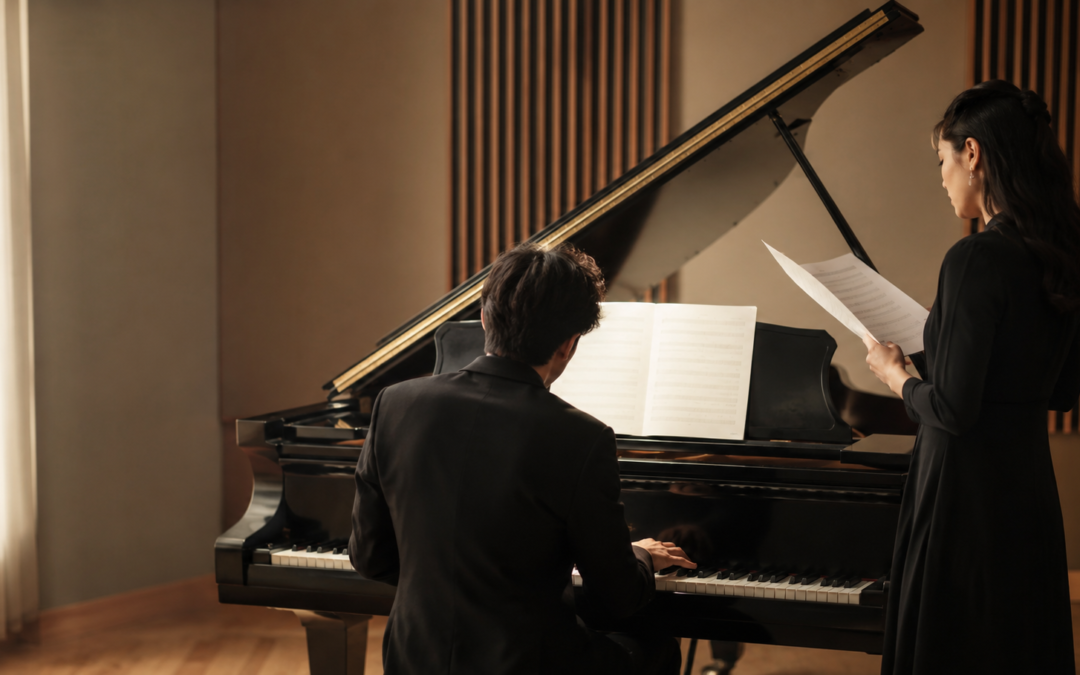
For Scott Michael Hamilton, collaborative piano has been an important part of a musical career that includes work with vocalists, instrumentalists, ensembles, musical theatre performers, and church musicians. His experience demonstrates why successful collaboration involves far more than simply playing the correct notes.
Accompaniment Versus Musical Collaboration
The terms accompanist and collaborative pianist are sometimes used interchangeably, but the second term better communicates the relationship between the musicians. The pianist may support a featured singer or instrumentalist, yet every performer shares responsibility for the interpretation, pacing, balance, and emotional direction of the music.
A collaborative pianist must understand the complete score—not only the piano part. The pianist pays attention to melodies, harmonies, entrances, phrasing, tempo changes, and the larger structure of the piece. This broader awareness makes it possible to anticipate what another performer needs and respond naturally in the moment.
The best collaborations do not sound like separate parts placed beside one another. They sound like one musical idea being communicated by multiple artists.
Preparation Begins Before the First Rehearsal
Much of a collaborative pianist’s work happens before anyone else enters the room. Learning the score thoroughly creates the foundation for a productive rehearsal. The pianist needs enough command of the music to look beyond the keyboard, hear the complete texture, and remain flexible when questions or changes arise.
Preparation also involves identifying moments that may require special attention. A difficult entrance, an unexpected tempo shift, a long vocal phrase, or a transition between scenes can affect the entire performance. Recognizing those moments early allows the musicians to use rehearsal time more effectively.
Scott’s musical background reflects the value of that preparation. He earned a Bachelor’s degree in Music Education from the University of Montana, where he studied piano with Professor Steven K. Hesla and choral education with Dr. David Edmonds. His combined study of piano and vocal music gave him experience viewing a score from more than one perspective.
Working With Vocalists
When collaborating with a vocalist, the pianist must listen closely to breathing, diction, phrasing, and the natural shape of the text. Singers cannot always approach rhythm and pacing in exactly the same way an instrumentalist does. A breath may influence the timing of a phrase, while the meaning of a lyric may call for flexibility that cannot be captured fully by printed notation.
The pianist supports the singer without overpowering the voice and helps establish a musical environment in which the vocalist can communicate clearly. That support might involve shaping a transition, adjusting balance, clarifying a cue, or allowing just enough space for a phrase to settle.
During his time at the University of Montana, Scott worked as a collaborative pianist with vocalists, soloists, and ensembles. Those experiences—including an appearance on Montana Public Radio—helped develop the attentive listening and adaptability that collaborative performance demands.
Collaborating With Instrumentalists and Ensembles
Instrumental collaboration presents its own musical questions. Every instrument has a different tone, range, articulation, and way of producing sound. A pianist working with a string player may need to respond to the shape of the bow and the time required for a note to speak. Collaboration with wind and brass musicians requires awareness of breath, resonance, and projection.
Balance is especially important. A grand piano can produce tremendous power, but musical partnership is not a contest for volume. The pianist continually adjusts touch, color, articulation, and dynamics so that the instruments complement one another.
Ensemble work adds another layer. The collaborative pianist must follow the direction of a conductor when one is present, remain aware of multiple performers, and contribute to a unified interpretation. This requires concentration, flexibility, and the ability to recover smoothly if something unexpected happens.
The Collaborative Pianist in Musical Theatre
Musical theatre is one of the clearest examples of the pianist as a central collaborator. During rehearsals, the piano may represent an entire orchestra while performers learn vocal parts, choreography, blocking, and dramatic timing. The pianist must follow the music while also remaining aware of the action taking place across the room.
Scott’s musical theatre work has included piano and keyboard performance, music direction, pit conducting, keyboard programming, and arranging. He has collaborated on productions with organizations including Montana Actors’ Theatre, the University of Montana, Missoula Community Theatre, Westside Theater, and the Bigfork Summer Playhouse.
That range of responsibilities provides a valuable perspective at the keyboard. A pianist who understands conducting, arranging, and music direction can see how an individual part fits into the production’s complete musical and dramatic structure. The goal is not simply to play accurately; it is to help the performers, orchestra, and production move forward together.
Listening Is the Essential Skill
Technique is indispensable, but listening may be the collaborative pianist’s most important ability. Musicians can prepare tempos, dynamics, and phrasing in advance, yet live performance always contains an element of change. A singer may hold a note slightly longer. A conductor may choose a different pace. An instrumentalist may shape a phrase in a new way. A scene may need an extra moment before the music continues.
The collaborative pianist notices those changes and responds without interrupting the musical flow. This kind of flexibility is not a departure from preparation; it is one of the reasons preparation matters. The better a pianist knows the music, the more freedom there is to listen and adapt.
Collaboration in Liturgical Music
The same principles apply in liturgical settings. Scott has served as a church musician since the third grade and currently works as Associate Director of Liturgical Music at Blessed Trinity Catholic Community in Missoula. As a Catholic pianist and organist, he helps prepare and lead music for worship.
In this environment, collaboration includes cantors, choirs, instrumentalists, clergy, and the congregation. The musician must support participation while remaining attentive to the movement and purpose of the liturgy. Leadership and sensitivity work together: the music must provide clear guidance without drawing attention away from worship.
Qualities of an Effective Collaborative Pianist
Every musical setting is different, but strong collaborative pianists consistently bring several qualities to their work:
- Preparation: knowing the score well enough to focus on the full performance.
- Active listening: responding to breathing, phrasing, balance, tempo, and tone.
- Flexibility: adjusting gracefully when a rehearsal or performance changes.
- Communication: discussing musical ideas clearly and respectfully.
- Reliability: arriving ready to contribute and support the shared goal.
- Musical sensitivity: recognizing when to lead, when to follow, and when to create space.
These qualities explain why collaborative piano is both a performance specialty and a form of musical leadership.
Scott Michael Hamilton and the Art of Musical Partnership
Scott’s work at the piano spans concert performance, educational settings, musical theatre, and Catholic liturgy. Although each environment asks something different of the musician, all of them depend upon the same foundation: careful preparation, thoughtful listening, and respect for the people creating the music together.
To learn more, explore Scott’s piano and performance experience, read about his work in music direction and musical theatre, or visit the About Scott page.
You can also read the first article in this series, Scott Michael Hamilton: A Life of Collaboration at the Piano. For professional inquiries or upcoming musical projects, please contact Scott Michael Hamilton.