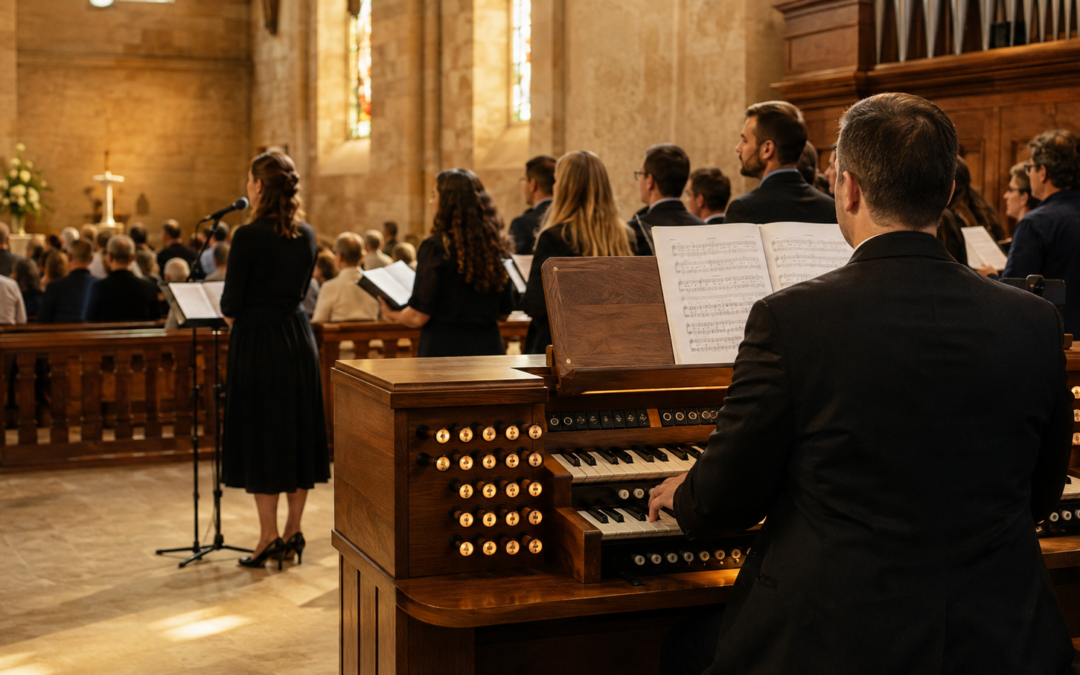
For Scott Michael Hamilton, liturgical music is not simply one area of professional experience. It is a lifelong commitment that began when he became an active church musician in the third grade. Today, Scott serves as Associate Director of Liturgical Music at Blessed Trinity Catholic Community in Missoula, Montana, where his responsibilities include helping select, prepare, rehearse, and lead music for worship.
His work as a pianist, organist, collaborative musician, and musical leader reflects the care required to serve both the music and the community gathered around it.
What Is the Role of a Liturgical Musician?
A liturgical musician does more than perform music inside a church. The role is shaped by the purpose and movement of worship. Each musical selection must fit within a larger context, and every prelude, hymn, response, acclamation, instrumental passage, and moment of silence contributes to the experience of the liturgy.
This requires a musician to think beyond individual pieces. The music must be prepared carefully, introduced clearly, paced appropriately, and led in a way that encourages participation. The musician must also remain attentive to clergy, cantors, choirs, instrumentalists, and the congregation.
In this setting, musicianship and service are inseparable. Technique makes the music possible, but sensitivity helps the music fulfill its purpose.
Selecting Music With Purpose
Thoughtful liturgical music begins with selection. The church calendar, readings, season, occasion, available musicians, and needs of the congregation can all influence what music is appropriate for a particular liturgy.
A strong selection should be musically suitable while also supporting the moment in which it will be used. Some occasions call for energy and celebration; others require restraint, reflection, or consolation. The range of music used across a year can be broad, but each choice should feel connected to the worship experience rather than added independently.
As part of his responsibilities at Blessed Trinity Catholic Community, Scott helps select and prepare music for worship. His background in piano, organ, choral education, and collaborative performance gives him several perspectives from which to consider a musical choice: how it supports the text, how it fits the liturgy, how it will be led, and how naturally the congregation can participate.
Preparing Music Before the Liturgy
Effective musical leadership depends on preparation that is often invisible to the congregation. Music must be reviewed, practiced, organized, and coordinated before worship begins. Cantors may need guidance with phrasing and entrances. Choirs may need help with balance, harmony, diction, or interpretation. Instrumentalists need clear music and an understanding of how their parts fit within the liturgy.
The pianist or organist must know more than the notes on the page. Introductions need to establish the melody and tempo confidently. Transitions should feel natural. Endings need to provide clarity. Accompaniments must support singing without overwhelming it.
Scott’s preparation is informed by a musical education that included piano study with Professor Steven K. Hesla and choral education with Dr. David Edmonds at the University of Montana. His experience working with vocalists, instrumentalists, and ensembles also supports the collaborative nature of liturgical rehearsal.
Piano and Organ: Two Distinct Musical Voices
Piano and organ are both keyboard instruments, but they create sound in very different ways. A pianist controls tone through touch, using the speed and weight of each key to shape articulation and dynamics. The sound begins to fade after the note is played, allowing the musician to create phrasing through attack, release, pedaling, and balance.
The organ sustains sound for as long as a key is held and offers a wide palette of tone colors through its registrations. The instrument can support a quiet reflective moment, provide clarity for congregational singing, or fill a large worship space with a broad and resonant sound.
Moving between the two requires more than transferring the same keyboard technique. Each instrument asks the musician to think differently about sound, articulation, texture, and space. Scott’s experience as both a Catholic pianist and organist allows him to choose the instrument and musical approach that best support a particular liturgy.
Supporting Cantors, Choirs, and Instrumentalists
Liturgical music is deeply collaborative. A cantor may lead a psalm or help guide congregational singing. A choir contributes harmony, energy, and additional musical texture. Instrumentalists can bring new colors to celebrations and special occasions. Each participant must understand both an individual role and the shared musical purpose.
The keyboard musician often serves as the musical foundation connecting these voices. That may involve following a cantor’s breath, adjusting balance beneath a choir, providing a clear entrance, or responding to an instrumentalist’s phrasing.
Scott’s work as a collaborative pianist is especially valuable in this environment. Collaboration requires close listening, flexibility, and the ability to support another musician without losing the direction of the complete piece. Those same skills help a liturgical ensemble remain unified and responsive.
Leading Congregational Singing
Congregational music differs from concert performance because the people gathered are not simply an audience. Their participation is part of the musical experience. The musician must provide enough confidence and clarity for a large group of people—with different voices, backgrounds, and levels of musical experience—to sing together.
A clear introduction establishes the melody and tempo. A supportive accompaniment helps the congregation continue confidently. The musician must understand when to provide strength, when to create space, and how to keep the music moving without making it feel rushed.
Leadership in this context is both audible and subtle. When it is done well, the congregation may not notice every decision the musician makes. They simply feel able to participate.
Remaining Flexible During Worship
Even the most carefully prepared liturgy includes live, human moments. A procession may take more or less time than anticipated. A speaker may pause. A cantor may shape a phrase differently. An instrumentalist may need an extra cue. The musician must remain attentive and adjust while maintaining a calm musical flow.
This flexibility is closely related to Scott’s work in collaborative piano and musical theatre. In each setting, the musician prepares thoroughly but stays present enough to respond to what is happening in real time. The ability to listen, adapt, and support others turns preparation into effective live leadership.
A Commitment That Began in Childhood
Scott has been an active church musician since the third grade. That early beginning gave him years to experience liturgical music from many perspectives: as a young musician learning to serve, as a pianist developing his technique, as an organist working with the sound of a sacred space, and as a leader helping others prepare music for worship.
A lifelong connection of this kind creates an understanding that extends beyond any single service or musical selection. Liturgical music follows communities through ordinary weeks, major celebrations, important transitions, and deeply personal moments. The musician becomes part of that continuing rhythm.
Liturgical Music as Service and Community
At its heart, Scott Michael Hamilton’s work in liturgical music brings together artistry, preparation, leadership, and service. The quality of the music matters, but so does the way it helps people gather, participate, reflect, and worship together.
Scott currently serves Blessed Trinity Catholic Community not only through music, but also as Financial Services Director and Facilities Manager. These different responsibilities share a commitment to supporting the parish and helping its daily work continue with care and organization.
Whether seated at the piano, playing the organ, rehearsing a cantor, guiding an ensemble, or preparing music for an upcoming liturgy, Scott approaches the work as part of something larger than an individual performance.
Learn More About Scott Michael Hamilton
Explore Scott’s liturgical music experience, learn more about his work in piano and collaborative performance, or read his complete story on the About Scott page.
Continue the series with Blog 1: A Life of Collaboration at the Piano, Blog 2: What Does a Collaborative Pianist Do?, and Blog 3: Inside Musical Theatre—from Piano to Podium.
For professional inquiries or to begin a conversation about music and collaboration, please contact Scott Michael Hamilton.