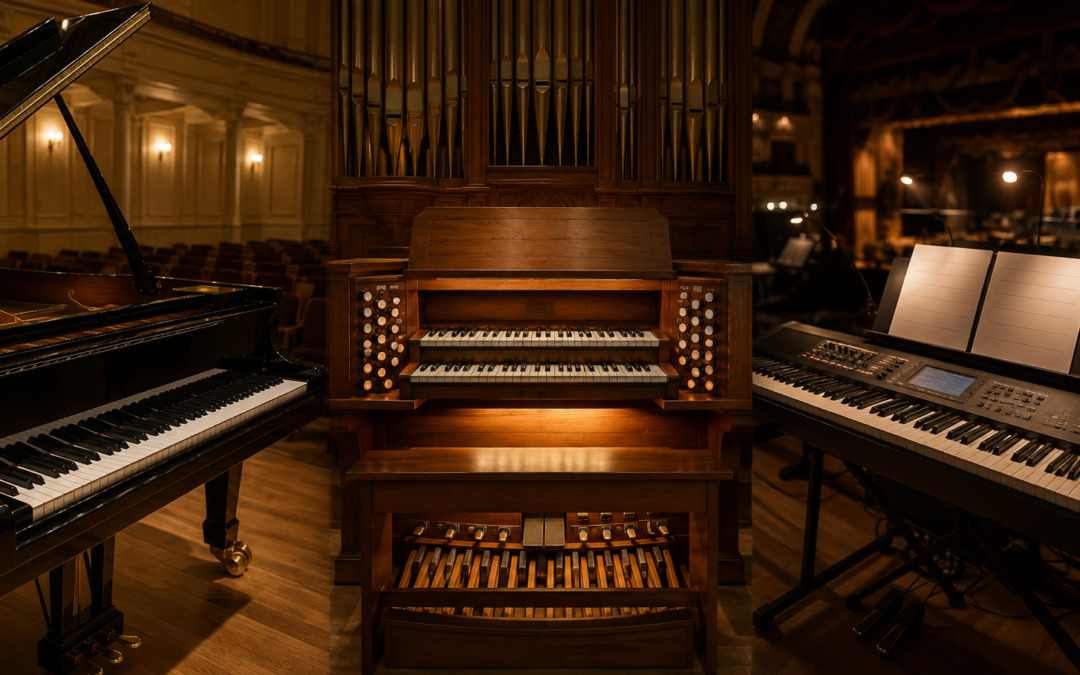
Scott Michael Hamilton works with all three. His performance background includes acoustic piano, organ, and electronic keyboards in settings ranging from collaborative recitals and musical theatre productions to Catholic liturgies.
Moving among these instruments requires more than keyboard familiarity. It calls for different approaches to touch, sound, balance, technology, space, and collaboration. Scott’s experience across these areas reflects the kind of versatility that allows a musician to serve the needs of the music rather than relying on a single instrument or performance style.
The Acoustic Piano: Touch, Tone, and Collaboration
The acoustic piano produces sound through a direct physical process. When a pianist presses a key, a felt-covered hammer strikes a string. The speed, weight, and character of that motion influence the beginning of the sound, while pedals affect resonance, connection, and color.
Because the sound begins to fade immediately after a note is played, pianists shape phrases through touch, timing, articulation, balance, and pedaling. A melody can sing above an accompaniment. A chord can feel brilliant or restrained. A repeated note can carry urgency, lightness, or calm depending on how it is approached.
These qualities make the piano especially expressive in collaborative performance. Scott has worked with vocalists, instrumentalists, soloists, ensembles, and other performers. In each collaboration, he must adjust his sound to complement the musician beside him.
A vocalist may need space to breathe and shape a text. A string player may approach a phrase through the movement of the bow. A wind instrumentalist may need the pianist to respond to breath and resonance. The piano part remains important, but its sound must be continually balanced within the complete musical conversation.
The Piano as an Orchestra in the Rehearsal Room
In musical theatre rehearsals, the piano often carries a different responsibility. Before the full orchestra arrives, a pianist may represent much of the score’s harmonic, rhythmic, and dramatic structure. Singers learn melodies and harmonies while actors add staging, choreography, dialogue, and characterization.
The rehearsal pianist must follow these moving parts while providing a dependable musical foundation. A scene may stop unexpectedly and begin again from the middle of a phrase. A director may request a different tempo. A performer may need a difficult passage repeated several times. The pianist must remain flexible without losing the larger structure of the show.
Scott’s experience as both a pianist and music director helps connect these responsibilities. He understands how the keyboard supports an individual performer while also representing the complete score and the production’s dramatic direction.
The Organ: Sustained Sound and Architectural Space
The organ asks a keyboard musician to think about sound differently. Unlike piano strings, which begin fading after they are struck, an organ tone can continue for as long as the key remains depressed. Changes in volume and color are created through registration, multiple manuals, pedals, and the instrument’s available resources.
The surrounding room also becomes part of the instrument. Organ sound moves through a worship space, interacts with its architecture, and reaches the congregation with a kind of scale and sustain that an acoustic piano cannot duplicate.
This means that phrasing on the organ depends strongly on articulation, release, texture, and timing. The performer must consider not only which notes to play, but also how sound enters the room, how long it continues, and how clearly separate musical lines can be heard.
Scott serves as an organist within the Catholic Church and currently works as Associate Director of Liturgical Music at Blessed Trinity Catholic Community in Missoula. His role includes helping select, prepare, rehearse, and lead music for worship.
Choosing Between Piano and Organ in Worship
Piano and organ can both support liturgical music, but they offer different expressive possibilities. The piano can provide intimacy, rhythmic clarity, gentle accompaniment, or a transparent texture around a cantor or ensemble. The organ can sustain congregational singing, create broad resonance, and offer many contrasting tone colors.
The appropriate choice depends on the music, the available musicians, the moment within the liturgy, and the character of the worship space. Sometimes one instrument provides the clearest support; at other times, a different keyboard voice better matches the text or occasion.
A musician who works with both instruments can approach these decisions from experience. Rather than treating the organ as a louder piano—or the piano as a smaller substitute for the organ—the performer recognizes the individual strengths of each.
Electronic Keyboards in Musical Theatre
Electronic keyboards open another world of musical possibilities. In contemporary musical theatre, a keyboard part may need to produce many contrasting sounds within a single performance. These can include piano and organ colors as well as orchestral, percussive, or synthesized textures.
The player’s responsibilities therefore extend beyond notes and rhythms. Sound changes must happen at the correct moment. Volume levels need to remain balanced. Transitions should feel seamless. The performer must understand how each sound functions within the complete orchestration.
Unlike a concert pianist who performs on one acoustic instrument, a theatre keyboard player may move through numerous sounds, layers, and technical cues while also following the conductor and responding to the performers onstage.
Scott’s musical theatre experience includes both piano and electronic keyboard performance. He has worked with productions involving Montana Actors’ Theatre, the University of Montana, Missoula Community Theatre, Westside Theater, and the Bigfork Summer Playhouse.
What Keyboard Programming Contributes
Keyboard programming is the process of organizing the sounds, changes, and settings required for an electronic keyboard part. The goal is to make the musical and technical demands of the score practical for live performance.
A well-prepared keyboard program helps the performer move reliably from one sound to another without interrupting the show. It can organize layers, balance levels, and place changes where they can be executed naturally. Good programming should support the score while remaining as invisible to the audience as the technology allows.
This work requires both musical judgment and technical organization. A sound may be impressive on its own but unsuitable within the orchestra. A transition may work technically but be difficult to execute during a complex passage. The programmer must consider the needs of the score and the realities of the performer.
Scott’s experience as a keyboard programmer complements his work as a pianist, arranger, music director, and pit conductor. Because he understands how keyboard parts function from multiple perspectives, he can consider both the individual player’s needs and the production’s larger musical structure.
Changing Instruments Means Changing the Musical Mindset
Keyboard skills provide a common foundation, but versatility depends on recognizing when that foundation must be adapted. The same musical phrase may require a different touch and sense of time on each instrument.
- At the piano, the performer shapes tone through touch, attack, release, balance, and pedaling.
- At the organ, the musician considers sustained sound, articulation, registration, multiple keyboards, pedals, and room acoustics.
- At an electronic keyboard, the player combines musical performance with sound selection, programmed changes, balance, and technical cues.
The instrument changes, but listening remains essential. Each keyboard must fit within a larger environment—an ensemble, theatre orchestra, singer, choir, congregation, or dramatic scene.
Preparation Creates Flexibility
A versatile keyboard musician must prepare carefully enough to respond when circumstances change. In collaborative performance, another musician may shape a phrase differently. In theatre, a scene transition may require additional time. During worship, a procession or spoken moment may be longer or shorter than anticipated.
Knowing the music thoroughly gives the performer room to adapt without losing direction. The musician can extend a passage, adjust balance, follow a conductor, support a singer, or move to a new cue while keeping the performance cohesive.
Scott’s experience across piano, organ, and electronic keyboards is connected by this balance of preparation and responsiveness. Technical knowledge makes the instruments available; listening determines how they should serve the moment.
One Keyboard Musician, Many Musical Roles
Scott Michael Hamilton works as a pianist, organist, collaborative musician, music director, pit conductor, keyboard programmer, and arranger. His ability to move among instruments supports an equally broad range of musical settings.
The acoustic piano allows him to collaborate closely with vocalists, instrumentalists, and ensembles. The organ connects his keyboard work to a lifelong commitment to Catholic liturgical music. Electronic keyboards place him inside the technical and orchestral world of musical theatre.
These are not separate identities. They are different expressions of the same musical purpose: understanding what the moment requires and using the right sound, instrument, and form of leadership to support it.
Learn More About Scott Michael Hamilton
Explore Scott’s work in piano and performance, learn more about his musical theatre experience, or read about his commitment to liturgical music.
Continue with Blog 7: Achievement Through Preparation, Blog 3: Inside Musical Theatre, or Blog 4: Music, Worship, and Community.
For professional inquiries, please contact Scott Michael Hamilton.